

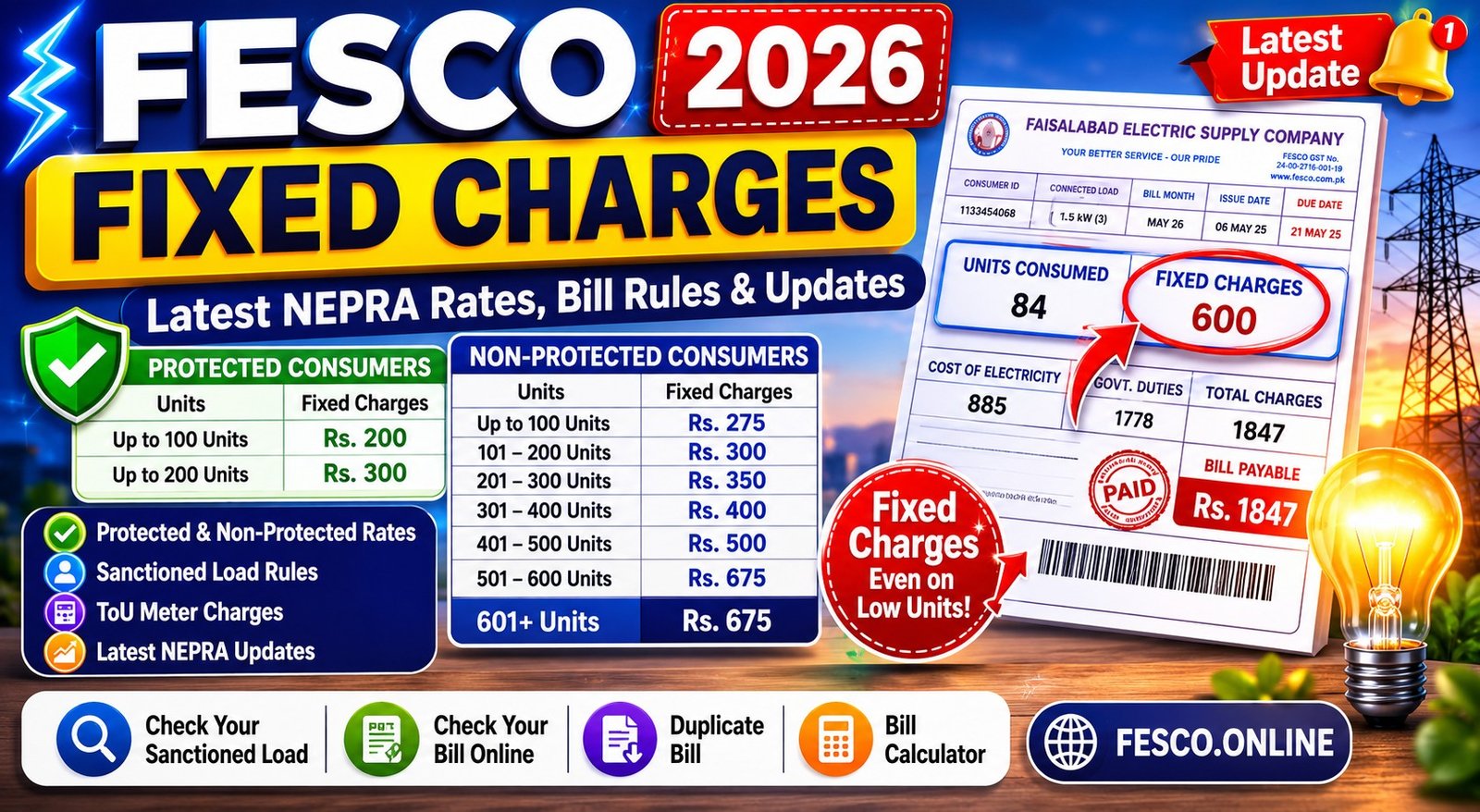
Electricity bills in Pakistan have changed significantly after the latest tariff reforms approved by the National Electric Power Regulatory Authority (NEPRA). One of the biggest changes is the introduction and expansion of fixed monthly charges for domestic consumers. FESCO Fixed Charges 2026
Many FESCO consumers were surprised to see fixed charges appearing on their electricity bills even when their monthly electricity usage remained low. In some cases, households consuming less than 100 units received bills containing hundreds of rupees in fixed charges.
If you are a Faisalabad Electric Supply Company (FESCO) consumer, this guide explains the latest FESCO Fixed Charges 2026, how they are calculated, who has to pay them, and why these charges appear on your electricity bill.
What Are FESCO Fixed Charges?
FESCO Fixed Charges are monthly charges added to your electricity bill separately from the normal per-unit electricity cost.
Previously, many domestic consumers only paid for the electricity units they consumed. Under the revised tariff structure, consumers may now pay:
- Energy Charges (based on units consumed)
- Fixed Charges (monthly charges applied according to tariff rules)
- Taxes and Duties
- Fuel Price Adjustments (when applicable)
This means that even if electricity consumption remains low, a fixed amount can still appear on the bill.
Why Has NEPRA Introduced Fixed Charges?
According to recent tariff decisions, the purpose of fixed charges is to help recover electricity infrastructure and capacity costs.
The government and power sector regulators argue that electricity distribution companies must maintain transmission lines, transformers, substations, and grid infrastructure regardless of how much electricity a household consumes.
As a result, a portion of these costs is now recovered through fixed monthly charges instead of relying entirely on per-unit billing.
Latest FESCO Fixed Charges Schedule 2026
FESCO Fixed Charges 2026
The following fixed charges have been reported under the revised domestic tariff structure approved by NEPRA.
Protected Consumers
Protected consumers are low-usage domestic consumers who meet NEPRA eligibility requirements.
| Monthly Units | Fixed Charges |
|---|---|
| Up to 100 Units | Rs. 200 |
| Up to 200 Units | Rs. 300 |
Non-Protected Consumers
| Monthly Units | Fixed Charges |
| Up to 100 Units | Rs. 275 |
| 101–200 Units | Rs. 300 |
| 201–300 Units | Rs. 350 |
| 301–400 Units | Rs. 400 |
| 401–500 Units | Rs. 500 |
| 501–600 Units | Rs. 675 |
Higher Consumption Consumers
| Monthly Units | Fixed Charges |
| 601–700 Units | Rs. 675 |
| Above 700 Units | Rs. 675 |
These figures represent the latest widely reported NEPRA-approved fixed charge structure for domestic consumers.
Important: Why Your Actual FESCO Fixed Charges May Be Different
Many consumers assume that fixed charges depend only on monthly electricity units. However, actual billing can vary depending on:
- Sanctioned Load
- Meter Type
- Time-of-Use (ToU) Connection
- Consumer Category
- Tariff Classification
- Maximum Demand Indicator (MDI)
For example, a FESCO consumer may consume only 84 units but still receive approximately Rs. 600 in fixed charges because billing calculations can also depend on sanctioned load and applicable tariff rules.
This is why two households with similar unit consumption may receive different fixed charges on their bills.
What Is Sanctioned Load?
Sanctioned Load is the approved electricity capacity assigned to your connection by FESCO.
It is measured in kilowatts (kW) and represents the maximum electrical load allowed for your connection.
Common sanctioned loads include:
- 1 kW
- 2 kW
- 3 kW
- 5 kW
- 10 kW
Higher sanctioned loads can increase applicable fixed charges under certain tariff categories. Several consumers across Pakistan have reported higher fixed charges linked to sanctioned load values shown on their electricity bills.
How to Check Sanctioned Load on Your FESCO Bill
You can find your sanctioned load directly on your electricity bill:
- Open your latest FESCO bill.
- Check the upper section containing consumer information.
- Locate the field labeled:
- Connected Load
- Sanctioned Load
- Load (kW)
The value displayed there can affect fixed charge calculations.
Time-of-Use (ToU) Consumers and Fixed Charges
Consumers using Time-of-Use (ToU) meters may face a different fixed charge calculation method.
According to reported tariff rules:
- Fixed charges can be calculated on the basis of sanctioned load.
- MDI (Maximum Demand Indicator) may also be considered.
- The higher value may be used for billing purposes.
Because of this formula, some ToU consumers have reported substantially higher fixed charges than ordinary residential consumers.
Do Solar Consumers Also Pay Fixed Charges?
Yes, in many cases solar and net-metering consumers may still pay fixed charges.
The reason is that grid infrastructure remains available even when a household generates electricity through solar panels.
Recent energy reforms and net-metering changes have increased discussion around fixed charges and grid maintenance costs.
Real Example from a FESCO Bill
A recent FESCO bill showed:
- Units Consumed: 84
- Cost of Electricity: Rs. 885
- Fixed Charges: Rs. 600
This demonstrates that actual fixed charges may not always match basic slab assumptions because sanctioned load and tariff category can affect final billing calculations.
Consumers should therefore check the “Fix Charges” section on their bill instead of relying solely on unit consumption estimates.
How to Reduce Fixed Charges on Your Electricity Bill
While fixed charges cannot usually be removed entirely, consumers may consider:
- Reviewing sanctioned load requirements
- Avoiding unnecessary load upgrades
- Monitoring billing category status
- Checking whether the meter classification is correct
- Contacting FESCO if billing appears inaccurate
Before requesting any sanctioned load reduction, consumers should ensure that their household appliances can operate safely within the revised load limit.
Frequently Asked Questions (FAQs)
Why am I paying fixed charges even when my electricity usage is low?
Fixed charges are separate from unit consumption charges and may apply regardless of monthly electricity usage.
Can fixed charges appear on bills below 100 units?
Yes. Under the revised tariff structure, even low-consumption consumers may receive fixed monthly charges.
Are protected consumers exempt from fixed charges?
No. Recent tariff changes extended fixed charges to protected consumers as well.
How do I know if I am a protected consumer?
Your electricity bill usually indicates the applicable tariff category. Consumers maintaining low usage over time may qualify as protected consumers.
Can sanctioned load increase my fixed charges?
Yes. In many situations, sanctioned load can affect the final fixed charge calculation, particularly for certain tariff categories and ToU connections.
Final Thoughts
The FESCO Fixed Charges 2026 system has changed how electricity bills are calculated across Pakistan. While monthly unit consumption still matters, sanctioned load, tariff category, consumer classification, and NEPRA regulations now play a major role in determining the final bill amount.
Consumers should carefully review their latest FESCO bills, verify their sanctioned load, and monitor the fixed charge section each month. Understanding these charges can help avoid billing confusion and provide a clearer picture of overall electricity costs.
Disclaimer: Electricity tariffs, fixed charges, taxes, subsidy policies, and billing rules may change through future NEPRA decisions or Government of Pakistan notifications. Consumers should verify the latest information from official FESCO and NEPRA sources before making financial decisions.
Last updated: 9 June 2026